
Transcript
Announcer:
Welcome to CME on ReachMD. This activity is provided by Medcon International. This episode is part of our MinuteCE curriculum.
Prior to beginning the activity, please be sure to review the faculty and commercial support disclosure statements as well as the learning objectives.
Dr. Nordestgaard:
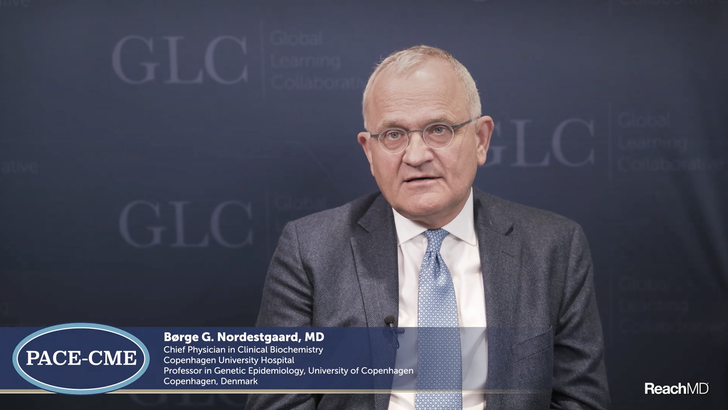
This is CME on PACE-CME and ReachMD. I am Børge Nordestgaard and with me here today is Professor Kosh Ray.
Dr. Ray:
Børge, pleasure to be here with you.
Dr. Nordestgaard:
Let's talk about APOC3. What is the role of APOC3 in lipid metabolism?
Dr. Ray:
So, the reason we're interested in APOC3 is, we're focused on triglycerides and triglyceride-related lipoproteins. And in blood, there are essentially two sources. There'll be dietary, so these large chylomicron particles, and there are the triglyceride-containing lipoproteins produced by the liver, VLDL. And we have an enzyme called lipoprotein lipase that's involved in the clearance of these lipoproteins and hence, triglycerides. And a key regulator of that is something called APOC3. So, lipoprotein lipase brings triglyceride levels down, increases the clearance of remnants. What APOC3 does is it inhibits lipoprotein lipase, so, effectively, making that process less efficient. So, if we have inhibitors for APOC3, we're going to increase the activity of lipoprotein lipase and improve clearance of triglycerides and their related lipoproteins.
Dr. Nordestgaard:
And then triglycerides go down.
Dr. Ray:
Will come down.
Dr. Nordestgaard:
Exactly. And so, on the horizon, we had these new RNA-based therapies; two different types. Will you be able to explain the different mechanisms between these two different types and how we should understand them?
Dr. Ray:
So, this really reflects an unmet need. We've never been able to lower triglycerides the sort of amounts that we're seeing now. And the beauty of RNA-based therapies is they're highly-specific. So, you have a gene that codes for a message and that message is then translated into a protein. So, we can silence the gene, effectively, by targeting the message, and we can do it in two ways at two sites. We can do that within the nucleus, and we can basically, use something called an antisense oligonucleotide, so the prototype for that is a compound called olezarsen. The dosing frequency of that is every month.
The alternative approach to do that is with something called a small interfering RNA, and this works in the cytoplasm, and the drug that we use, or the prototype is the plozasiran. And this one is a double-stranded RNA, and what this allows is less frequent dosing, every 3 months rather than monthly. But both give you substantial reductions in APOC3 of the order of 70 to 80%, with then substantial reductions in triglycerides.
Dr. Nordestgaard:
OK, fantastic. Well, it's been a very great micro-discussion. But before we wrap up, Kosh, what’s your final take-home message?
Dr. Ray:
So, we've previously not being able to target this regulatory pathway. We now have injectable therapies that are approved, and either they are every 1 month and they're called antisense oligonucleotides, or every 3 months and they're called small interfering RNA's. But they actually help us with an unmet need.
Dr. Nordestgaard:
So, that's all we have time for today, so I want to thank the audience for listening in and thank Dr. Ray for joining me and sharing all your valuable insights and expertise. It was great speaking with you today.
Dr. Ray:
Great. Thank you.
Announcer:
You have been listening to CME on ReachMD. This activity is provided by Medcon International and is part of our MinuteCE curriculum.
To receive your free CME credit, or to download this activity, go to ReachMD.com/CME. Thank you for listening.

